

 By
By What does it take to make a good commercial masala movie? Action converted as style? Bring it on. A dash of categoric machoism? No one said no to it ever! A brooding, temperamental hero who smashes heads and lights up a cigarette in slow motion? Absolutely. And, of course, a set of side characters who serve as foils to the protagonist while contributing little to the narrative. If we take the case of Deva, it fits this bill perfectly.
The film is fast-paced, never loses momentum, and keeps the audience engaged, constantly making them question who the real villain is. Shahid Kapoor, in his element, plays a badass mafia policewala—a man with his own rules, his own people, and a rage that erupts at the slightest provocation. He is violent, impulsive, and above all, always angry. Not the subtle kind of anger that simmers under the surface, but an explosive, ever-present rage that manifests in every situation—whether he’s dealing with criminals, grieving for a friend, or simply being made to wait.
But watching Deva also sparks a familiar thought—we have seen this man before. It’s the kind of stylised masculinity that has long defined Indian mainstream cinema.
This brand of the angry, hyper-masculine protagonist is in fact, one of Indian cinema’s most enduring character tropes. More particularly, Bollywood has long been obsessed with men who wear their rage like a second skin. But what is interesting is how this anger has evolved—from being a collective frustration against the system to something far more personal and self-destructive.
That said, this is not about condemning movies. Cinema has never been a moral guidebook, nor should it be. Films exist to entertain, to create larger-than-life moments, and to reflect emotions in their rawest, most heightened forms. But as patterns emerge over decades, it becomes interesting to observe how our heroes (read angry young men)—and their anger—have transformed.
The Birth of the Angry Young Man
The “angry young man” itself is synonymous with Amitabh Bachchan. It all began with Zanjeer (1973), a period when India was grappling with economic struggles, unemployment, and political unrest. The country needed a hero who could channel its frustrations, and Bachchan’s Vijay stepped up to the task.
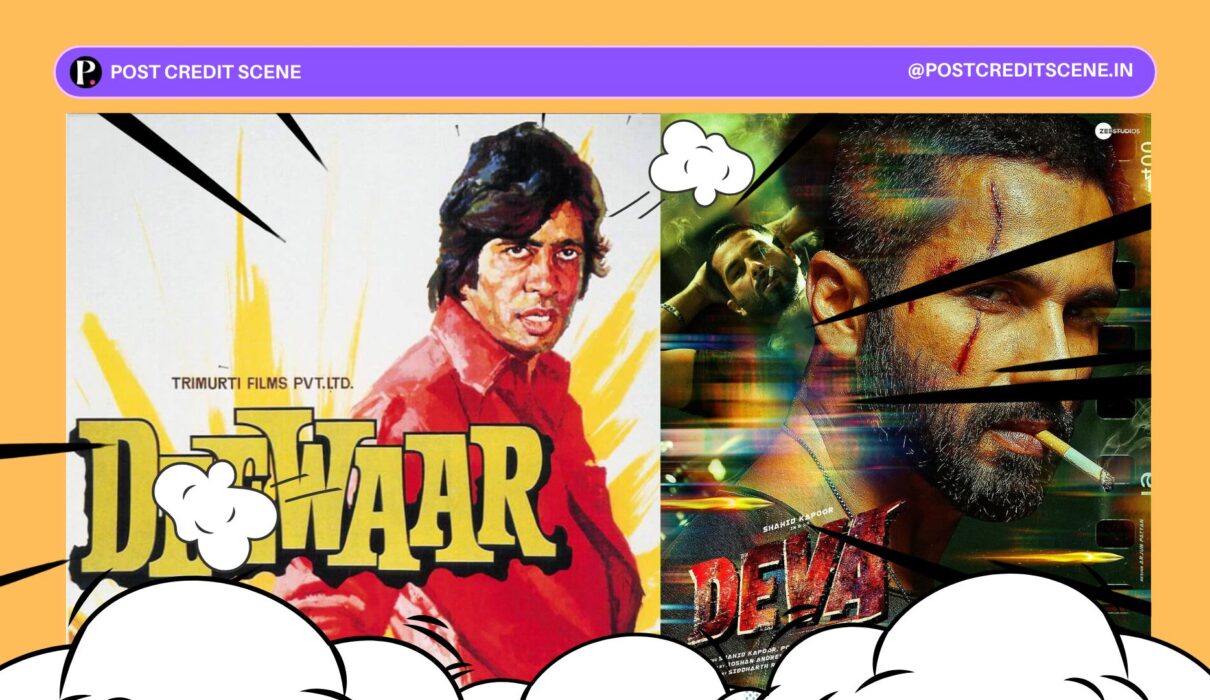
Think of Deewaar (1975)—the film that defined the archetype. The scene where Vijay confronts his brother (played by Shashi Kapoor) remains one of the most iconic moments in Indian cinema. He asks: “Aaj mere paas buildingein hain, property hai, bank balance hai, bangla hai, gaadi hai… Tumhare paas kya hai?”
And his brother simply responds: “Mere paas maa hai.”
The anger is closer to home, as he rebels against a society that treated his mother unfairly. And then came Agneepath (1990), where his wrath reached its peak—Vijay was no longer just fighting injustice, he became the underworld itself.
The key distinction? His anger had a cause. Whether it was a corrupt police force, an exploitative system, or an unfair class divide, his fury was a weapon aimed outward, not inward. The audience saw his rage as a reaction, not a personality trait.
Fast forward to today, and the angry man has changed.
The New-Age Angry Man
Cut to the 2010s and 2020s, and the hero’s rage has become… personal.
Consider Kabir Singh (2019). His anger is no longer about a failing system—it’s about losing a woman. In Ranbir Kapoor starrer Animal (2023), Ranvijay’s rage stems from a troubled relationship with his father. This character exists in a vacuum where violence is both the cause and the cure.
And in the latest release Deva, Shahid’s character that stems from a traumatic childhood erupts into violence over anything, like something as simple as being asked to wait for his mobile phone to be repaired.
The cause of anger has shifted. Earlier, rage was a symbol of resistance; now, it’s an unchecked personal trait. Anger is no longer a response—it is the hero’s entire personality.
And let’s be honest—this shift has made our heroes more flawed, more human, and perhaps more intriguing. After all, cinema has evolved from simple moral binaries to complex, layered characters. But in the process, are we normalizing self-destructive rage as aspirational?
Because not all angry young men are violent. There’s Vikram Vedha (2017), where Vijay Sethupathi’s Vedha is a man driven by the loss of his brother and the inherent hypocrisy of law enforcement. Here, anger is nuanced—it’s not about blind aggression but about questioning morality and power structures.
Even Suriya’s Jai Bhim (2021) took the archetype in a different direction—replacing physical rage with relentless pursuit of justice. The film showcased a legal battle rather than a physically violent one, proving that anger can be channeled into systemic change rather than just fists and bullets.
The Fine Line Between Glorification and Storytelling
None of this means that films should stop portraying flawed, angry protagonists. Fiction, at its core, thrives on heightened drama, and a character’s aggression often makes for compelling storytelling.
But how we frame this aggression matters.
Look at Arjun Reddy/Kabir Singh. While the film explores a deeply troubled character, the audience perception largely turned him into an alpha symbol rather than a cautionary figure. Similarly, in Animal, Ranvijay’s anger is visually stunning—slow-motion shots, intense background scores, on point cinematography. It’s hard not to be mesmerized by his destruction.
And that’s where the debate lies—not in what is shown, but in how it’s received by us as the audience.
It’s one thing to showcase a flawed, angry hero. It’s another to package his anger as cool.
Where Do We Go From Here?
At the end of the day, movies are entertainment. They are not meant to teach morality, nor should we expect them to. A film like Deva or Animal exists to deliver adrenaline and spectacle. And there’s nothing wrong with that.
But as we continue to celebrate these characters, it’s worth asking—what happens when the angry young man is no longer fighting the world, but just fighting himself? And more importantly, how much of that fight do we want to glorify?
Perhaps the next evolution of the “angry young man” isn’t about suppressing his rage, but about challenging it. After all, anger is only compelling when it leads somewhere. Otherwise, it’s just noise.